Pandemic, Pine, and Charlie Brown’s Christmas Tree

Previously published on December 21, 2020 on my old blog during a very sad and lonely Covid Pandemic Christmas.
--

Finding the “true meaning of Christmas” is something Hollywood wants you to think is more ethereal and challenging than it actually is. When I was young it was about presents and Jesus. Now that I’m older, I’ve realized the real value of the holiday winter break is simply because it is the only time of year were a large number of people collectively get a break. Yes, this isn’t true for a lot of people. But more of us get a break than any other time of year. The meaning of Christmas is getting a break with those you care about. Nuff said.
What I am really saying here though is I’m officially homesick for Southwestern Ontario. I hate it. I’m thirty-three hundred kilometers away in Vancouver and can’t go home for Christmas.
What really has me aching, is how different the landscape is in BC this time of year. Especially the trees. The otherworldly massive evergreens of the coastal forests of BC still stupefy me, but they also leave me yearning for the snow-covered deciduous forests of Ontario. The climate is much too wet for Ontario trees to grow here.
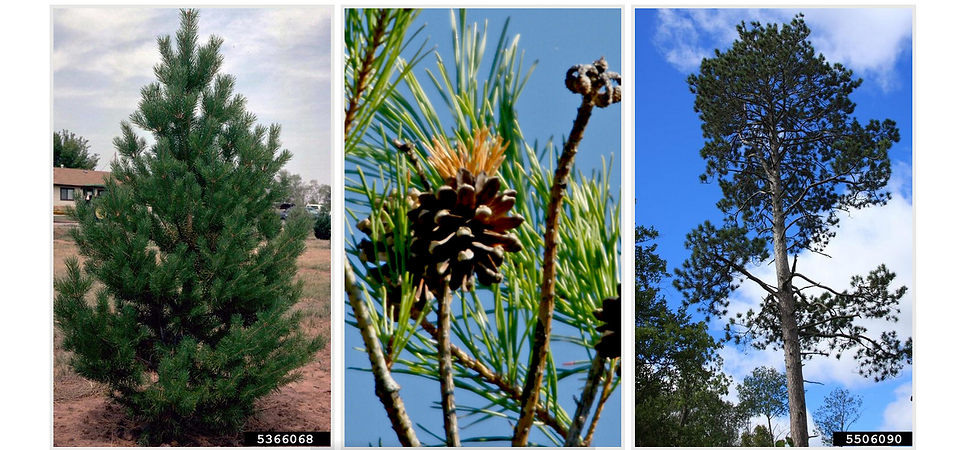
However, there’s one tree commonly planted in Vancouver’s smaller parks that still reminds me of home…. despite not actually being from my home. It’s the original Christmas Tree. The European Red Pine. Commonly known in Canada as the Scots Pine, Pinus sylvestris.
Before I moved out to Vancouver, a friend and I hiked Huron Natural Area in Kitchener, Ontario. It’s one of the few preserved “natural” forests left in Southwestern Ontario. That “natural” is a loaded term. There’s been a shift in the last decade when it comes to talking about the history of North American forests. The history books still tell of Canada’s forests before Europeans arrival as untouched and wild. However, the scholarly literature opinion on that fact has changed. Canadian Forests were managed, cared, and protected for just like we do for our forests now.
There’s a bit of a mental leap here required to grasp this concept. I often find myself slipping out of it and then re-realizing it when I’m thinking about the history of a forested area. It’s contrary to what has been ingrained so deep in the minds of White Settlers, but Indigenous populations were equal to European populations before Europeans arrived. North America wasn’t empty. It was full. They just knew how to live on the land and not suck it dry. How to live with it instead of against it.
Huron Natural Area was a home for Indigenous People for thousands of years. It’s Southwestern Ontario location means it is surrounded by the Great Lakes, ensuring mild temperatures and lots fresh water. The soil quality is incredible. Plant and wildlife diversity were bursting at the seams back then. It was a paradise. There’s a reason why Southwestern Ontario is the most populous area of Canada.
I was in awe hiking through Huron and seeing the towering descendants of the great trees that once grew in this Indigenous home. Strangely though, there was also a whole area of the forest on the edge of Huron Natural Area that only had one tree. It wasn’t a tree native to the region. It wasn’t one the Indigenous people knew. It was an old Christmas Tree plantation of Scots Pine planted by European Settlers.
Scots Pine was the first tree widely introduced to North America by Europeans. You can find it now in disturbed forests around any North American city. It’s now an incredibly far-reaching tree, perhaps the tree that stretches over the largest land mass. In its native range alone, it covers an obscene amount of land area. All of Europe and Russia, and even some of North Africa.
It’s one of the easiest trees to identify as well. it has bluish-green needles in pairs of two a bit shorter than the length of your thumb. The real trick though, is if you look to the top of the trunk on mature trees you will see orangish-red peeling bark, which is in contrast to the greyish/brownish fissured plates on the bottom of the trunk.
![Scots Pine Peeling bark [ via http://www.bio.brandeis.edu/]](https://static.wixstatic.com/media/8d590c_1d57eba333de4386bb067f6afba603e9~mv2.jpg/v1/fill/w_193,h_262,al_c,q_80,enc_avif,quality_auto/8d590c_1d57eba333de4386bb067f6afba603e9~mv2.jpg)
Scots Pine deserves the title of The Christmas Tree. It was the most popular christmas tree in the original Germanic Christian tradition. The stiff branches hold ornaments and (as was the practice at the time) candles better than other evergreen trees can. The bluish-green needles create a magical glowing affect when light hits them. And, maybe most importantly, it has the best needle retention of all the christmas trees. This means very little mess, but also creates the illusion that the tree is still growing and flourishing despite the fact that it has been cut in half and placed in your living room.
A dead tree that still seems to somehow be alive. A miracle. A gift. No wonder Christians adopted Germanic pagan traditions of placing Scots Pines in their homes during the winter as a reminder of spring and reinvented it around Jesus’ birthday.
I read a fascinating piece the other day about how the movie “A Charlie Brown Christmas” saved the christmas tree industry. People had been shifting to cheaper, reusable, fake christmas trees in early 60s. When the movie came out in 1965 and became an instant beloved classic, people wanted real christmas trees again. That sad, little, ragged tree Charlie Brown had? The two-bunched needles. The stiff branches. It’s distinctively a struggling Scots Pine sapling.
Charlie Brown only being able to find such a pathetic looking tree is probably a more astute observation on tree biology than Charles Schulz meant it to be. In the mid-1990s, after a few decades of mass planting Scots Pine for lumber and christmas trees, Tree Experts began to notice the Scots Pine actually wasn’t growing that well in North America. They didn’t get anywhere as near tall or straight as they did in Europe. They grew hutched over, always seemed to be attacked by disease, and died young.
The reason behind this seem to be in part bad original seed source from Europe but more so the fact that North America has a very different climate than Europe. This isn’t the Scots Pine home. It’s not its habitat. Soon Scots Pine growth problems resulted in it starting to be replaced with the easier to manage Fir and Douglas-fir trees as the favourite North American Christmas tree.
However, Scots Pine is one hell of a tough tree. A lot of its christmas tree plantations, like the one in the Huron Natural Area, were abandoned and trees were left free to grow. And grow they did. It’s now considered a naturalized invasive species in Ontario. It aggressively invades and outgrows native’s species in sensitive ecosystems. It’s doesn’t live long, but it does live long enough to produce seeds and ensure there will always be more Scots Pine.
Seeing Scots Pines alongside the preserved forest of the Huron Natural Area or as christmas tree in someone’s window, it’s hard not to see them as heavy-handed metaphors for colonization and capitalism. Their European settler ties, their invasion of natural areas, and their boom-bust cycle of christmas capitalism.
But on the other hand, it’s just a tree, not a human. They are out there doing their best. Tossed into a new world and forced to survive. Out there taking on all comers and just scratching by. Surviving. Be the Charlie Brown christmas tree this year. Be a withered, tiny Scots Pine holding a large ornament. Bend. Don’t break.


